


Quartz vs granite countertops — Boston homeowners face this decision as one of the biggest choices during a kitchen renovation.
For Boston homeowners looking for expert guidance, Pablo Marble and Granite has helped hundreds of Greater Boston families choose the right surface for their kitchen
Knowing these differences really helps you zero in on the right surface for your lifestyle—and your wallet.
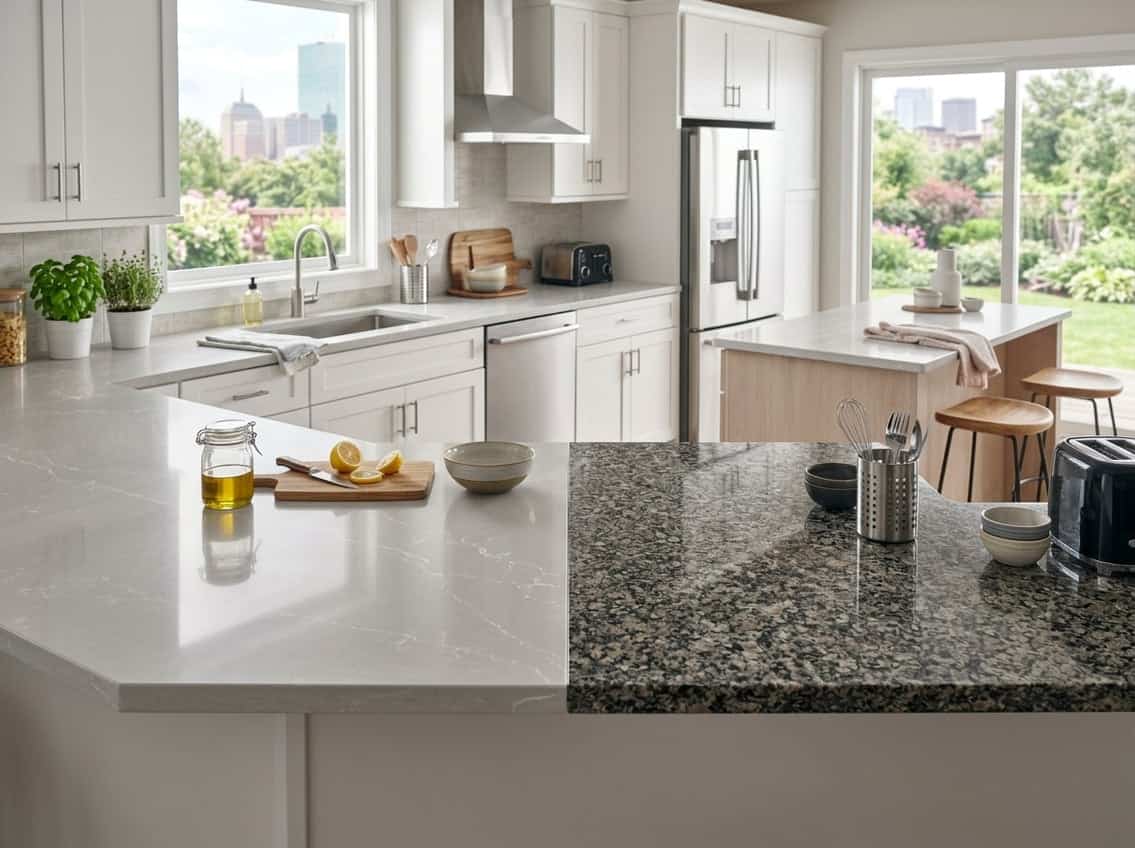
In Greater Boston, quartz countertops run $70-$200 per square foot installed. Granite usually falls between $50-$200 per square foot, but you’ll need to seal it each year.
Quartz is engineered—crushed quartz crystals and resin—so you get predictable patterns and solid stain resistance. Granite is all-natural, straight from the earth, with one-of-a-kind patterns and top-notch heat resistance.
Here in Boston, about 70% of kitchen projects lean toward quartz, especially for busy families in places like Newton, Wellesley, and Brookline. Granite still holds its own in historic spots like Beacon Hill and Back Bay, where it just fits those classic brownstones.
Key Takeaways
- Quartz doesn’t need sealing and shrugs off stains. Granite handles heat and brings those wild natural patterns.
- Boston installation costs usually range from $50-$200 per square foot, depending on the details.
- Most folks around here pick quartz for the low maintenance. Granite still shines in traditional homes and outdoor kitchens.
Quartz vs Granite Countertops Boston: Key Differences
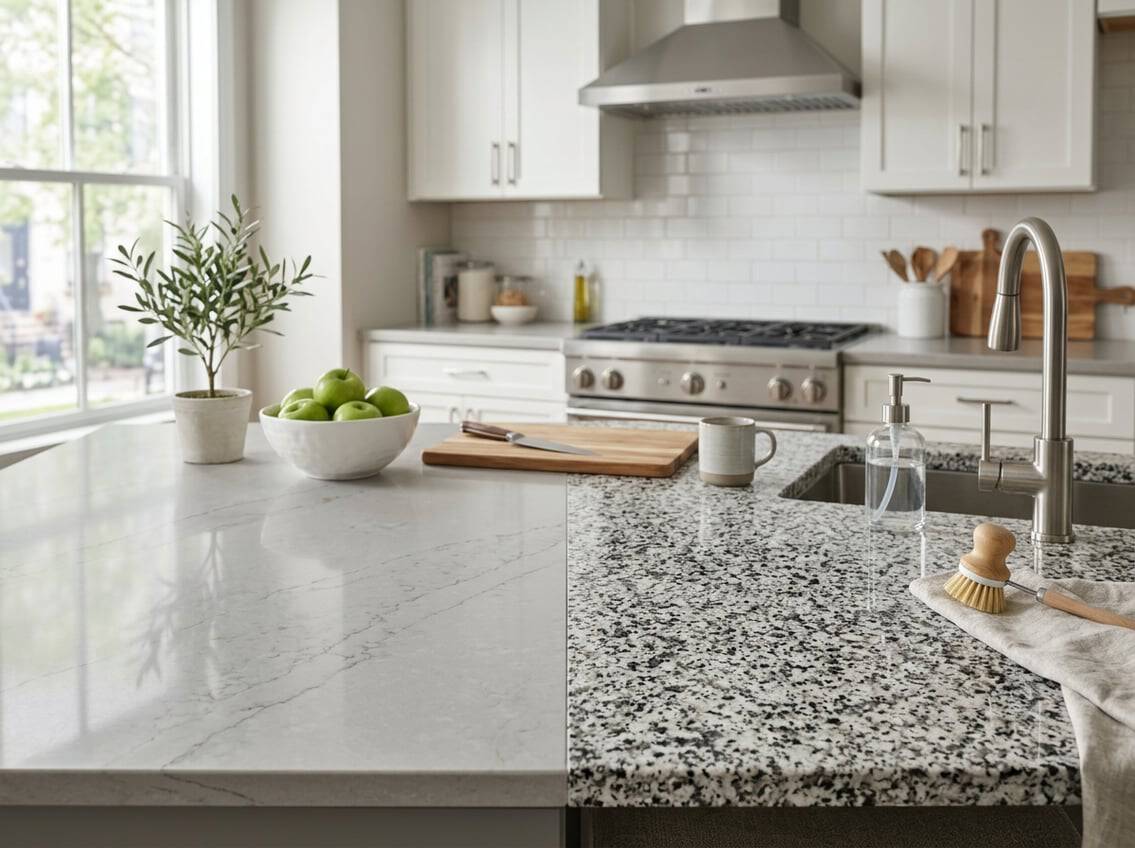
Quartz and granite countertops might look similar at first glance, but their makeup, how they’re made, and how they handle daily kitchen life are pretty different. Knowing these basics makes the choice a whole lot easier for New England homeowners.
Natural Stone Versus Engineered Stone
Granite countertops are 100% natural stone, cut straight from ancient rock formations. Quarries pull out massive blocks that formed from volcanic activity millions of years ago. Each slab? Totally unique—no repeats, ever.
Quartz, on the other hand, is engineered in a factory. It’s usually about 93% crushed quartz mixed with resin and pigments. That process lets manufacturers dial in the look, so you get consistency and control.
If you love natural, one-of-a-kind materials, granite’s your pick. If you want a specific look, or maybe you’re a perfectionist about color matching, quartz is hard to beat.
How Each Material Is Made
Granite starts at the quarry. Workers cut out giant chunks from the bedrock, then send those blocks to fabrication shops. There, they’re sliced, polished, and prepped for your kitchen. They don’t add anything except a sealer at the very end.
Quartz gets mixed up in the factory—crushed quartz, resin, color, all blended together. They pour it into molds, vibrate out any bubbles, and cure it under pressure. Out comes a solid, uniform slab.
This is why quartz is so consistent, and granite always has those natural quirks. Factories control quartz’s look, but granite’s appearance is all geology.
Major Performance Gaps
Quartz barely needs any maintenance—its resin surface blocks stains and never needs sealing. Granite, though, is porous. You’ve got to seal it every year to keep out moisture and stains. You can use any regular cleaner on quartz, but granite needs gentle stuff to avoid dulling the finish.
Granite wins on heat resistance. You can set hot pans right on it without worry. Quartz’s resin can scorch if you go above 300°F, so you’ll want to keep hot pads handy. Both stand up well to scratches, but their toughness comes from different sources.
Pricing’s all over the place—both materials average $80 to $150 per square foot installed in 2026. Granite prices swing more with quarrying costs and what’s available, while quartz tends to stay steadier.
Aesthetic Appeal and Style Options
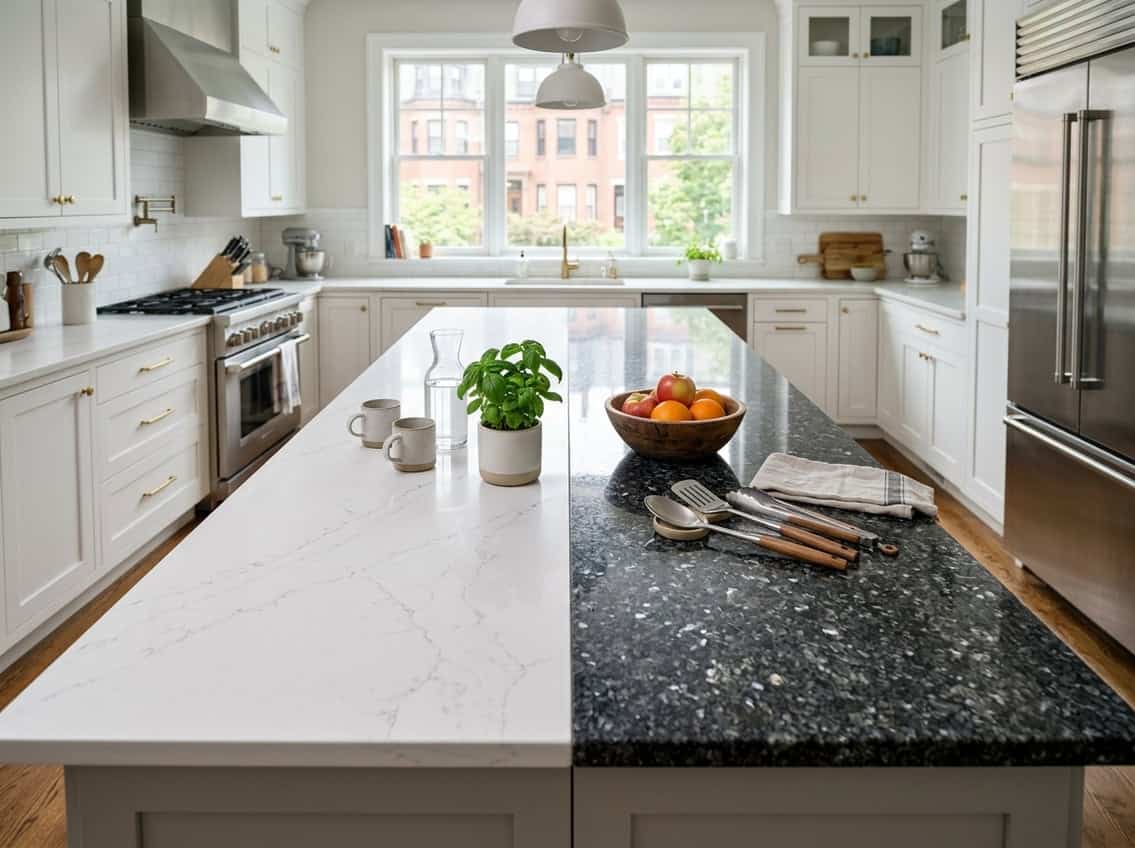
Granite and quartz each bring their own style. Granite’s got that natural variation—no two slabs are ever the same. Quartz, being engineered, comes in a wider range of colors and patterns, including some wild options you won’t find in nature.
Grain, Color, and Pattern Variations
Granite shows off mineral patterns that formed deep underground. You’ll see veining, speckles, and colors from subtle grays to bold blues, reds, and even golds. The look shifts with the light—sometimes it’s dramatic, sometimes mellow.
Quartz can mimic stone or go for solid colors and modern patterns. Brands like Cambria and Caesarstone keep cranking out new looks—some even have metallic flecks or recycled glass. Quartz colors range from snow white to jet black, and even bold shades like blue or green.
Consistent Versus Unique Looks
With granite, you really need to pick your slab in person. Even two pieces from the same block can look pretty different. That uniqueness is a big draw for a lot of Boston and Cambridge homeowners.
Quartz is all about consistency. If you want your island and perimeter countertops to match exactly, quartz is the way to go. What you see in the showroom is what you’ll get at home.
Suitability for Modern and Traditional Designs
Granite fits right in with traditional, rustic, or even transitional kitchens. It pairs beautifully with wood cabinets and classic details. Dark, dramatic granites make a statement in high-end kitchens—think Newton or Wellesley showpieces.
Quartz is versatile. Clean white quartz with subtle veining looks fantastic in modern spaces with flat-panel cabinets and stainless appliances. Some quartz styles mimic marble or granite, so you can get that classic look without extra maintenance. The engineered options open up all sorts of design possibilities you just can’t get from natural stone.
Durability, Longevity, and Daily Performance
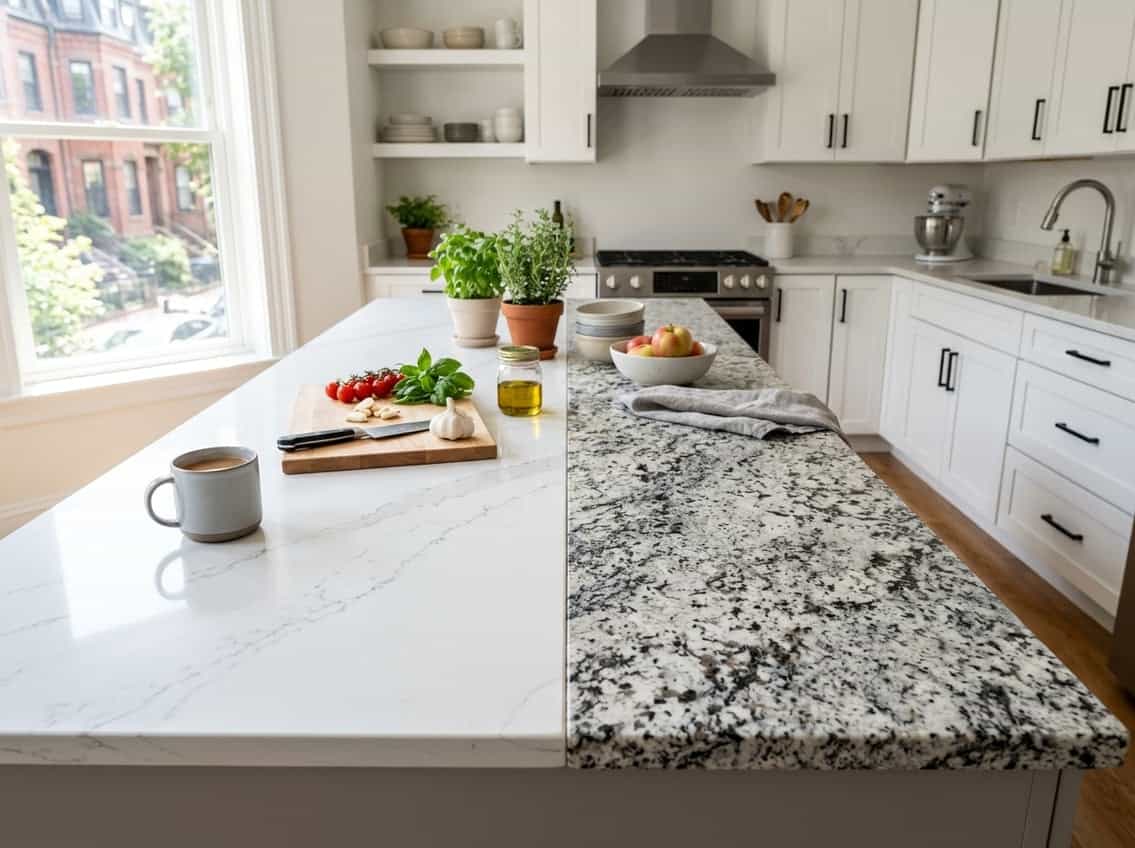
Both options stand up to real kitchen life, but they react differently to heat, impact, and stains. If you’re weighing your options for a busy Massachusetts home, these details matter.
Heat Resistance and Scratch Resistance
Granite shrugs off heat. You can put a pan straight from the oven onto it—no problem. It can handle temps up to 1200°F, so you’re not likely to run into trouble.
Quartz is more sensitive. It’s fine up to 300°F, but anything hotter can scorch the resin. Always use a trivet or hot pad with quartz. Both materials have a Mohs hardness of about 7, so normal kitchen scratches aren’t an issue for either.
Chipping, Cracking, and Impact Factors
Granite can chip at the edges if you drop something heavy. Repairs are possible, but you’ll probably always notice where the chip was.
Quartz is a bit more forgiving. The resin gives it some flexibility, so it’s less likely to chip. Edges hold up well—even in busy kitchens.
| Material | Edge Durability | Impact Resistance | Repair Visibility |
|---|---|---|---|
| Granite | Moderate | Lower | Visible |
| Quartz | High | Higher | Minimal |
Granite, with care, can outlast a century. Quartz usually goes strong for 25 years or more—longer than most folks stay in one house anyway.
Stain Resistance and Porosity
Quartz is non-porous, so coffee, wine, lemon juice—they all wipe right off. No sealing, no stress. Just use soap and water.
Granite is porous. You’ll need to seal it every year. If you skip that, spills can soak in—red wine and oil are the usual suspects for stains. So, if you’re a little forgetful with maintenance, quartz might be the safer bet for your Boston kitchen.
Cost and Value in the Boston Market
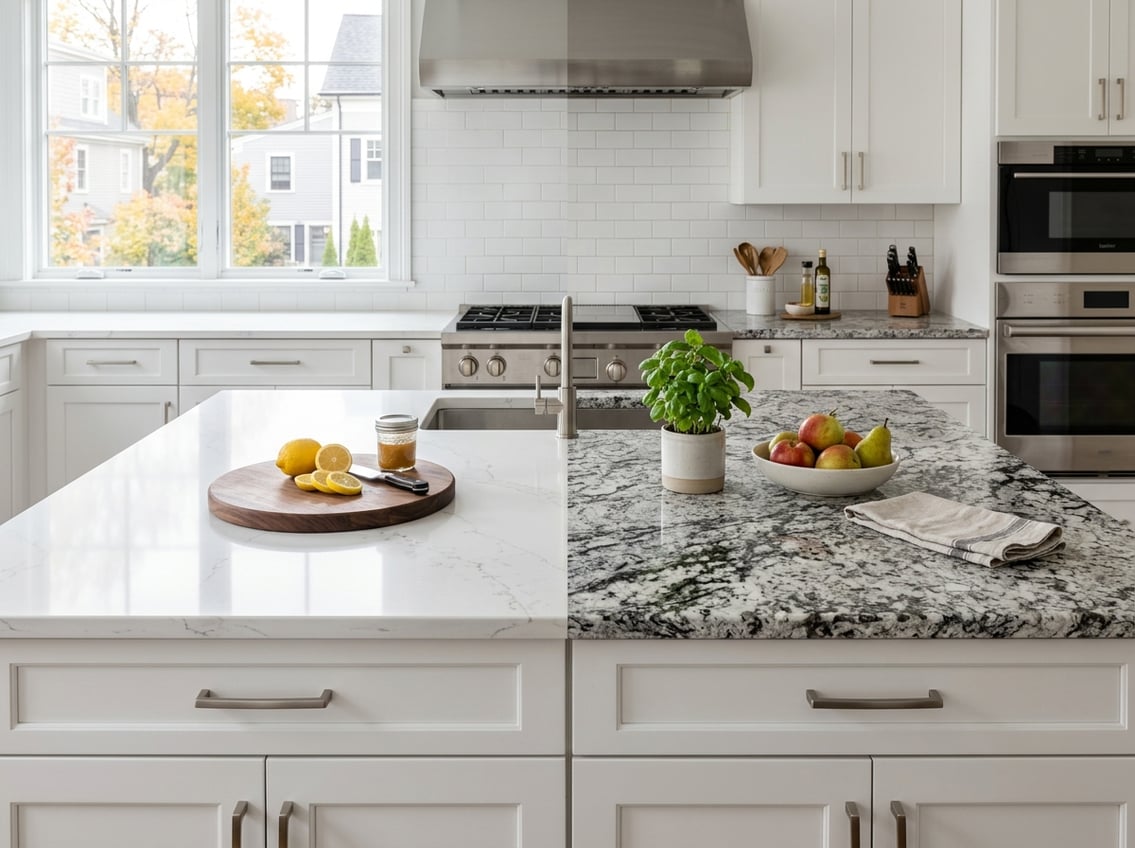
If you own a home in Boston, you’ll usually pay somewhere between $55 and $150 per square foot for installed quartz or granite countertops. Material quality, project complexity, and the contractor you pick all play into the final price, and both stone types overlap across all price points.
Installed Price Ranges
Quartz and granite run in similar price ranges around Boston. That $55 to $150 per square foot covers just about every option you’ll see locally.
Price isn’t just about the material. You might find a quartz slab that’s cheaper than granite, or a granite that costs more than some high-end marble. It really comes down to which stone you pick, not whether it’s natural or engineered.
Take mid-range quartz like Calacatta Idilio and Carrara Morro—Boston-area contractors quote wildly different prices for the same stuff. I’ve seen recent bids for an 83.4 square foot job swing from $4,762 to $7,755. Who you hire impacts your wallet as much as your countertop choice.
Factors Affecting Cost
Plenty of things besides the stone itself drive up the final bill. Stone quality matters a ton, especially when you’re eyeing rare colors or premium patterns in either quartz or granite.
Contractor details make a difference:
- Company size and their overhead
- Years they’ve worked in Massachusetts
- Whether they do their own fabrication
- Warranty coverage and what it actually includes
- How deep their consultations go and if they actually listen
Project complexity adds up too. Fancy edge profiles, backsplashes, cutouts for sinks or cooktops, and tricky layouts all mean more labor. Thicker slabs? They bump up both material and install costs, no matter which stone you pick.
Resale Impact and Return on Investment
Quality stone countertops pay off when it’s time to sell. Boston buyers notice kitchens with quartz or granite—these upgrades stand out in our local real estate market.
Right now, buyers lean a bit toward quartz for its clean look and even patterns. Still, granite (and marble) hold their own, especially in historic homes or higher-end properties.
Both materials add solid value at resale. Honestly, your return depends more on the whole kitchen and what’s expected in your neighborhood. In Boston, buyers just assume updated kitchens come with quality stone—anything less is a red flag.
Maintenance and Care Requirements
Granite needs sealing once a year and quick cleanup if you spill. Quartz? No sealing at all—it shrugs off stains naturally. The two stones call for different cleaning habits, and that matters for long-term durability here in New England.
Read our complete Granite Countertops Boston MA guide
Sealing,link Cleaning, and Upkeep
Granite countertops need professional sealing at least yearly, or you’ll risk stains and moisture damage. Since granite’s porous, water and other liquids can seep in if you skip this step. I usually tell folks to drip a little water on the surface—if it beads, you’re good. If it soaks in, it’s time to reseal.
Quartz is different. Since it’s made from crushed stone and resin, it’s non-porous and never needs sealing. The manufacturing process locks out liquids and stains.
Daily cleaning is a bit different for each:
- Granite: Warm water, mild dish soap, soft cloth. That’s it.
- Quartz: Water and gentle cleaners, but skip the bleach and anything abrasive.
- Both: Wipe spills right away and avoid harsh chemicals.
Quartz handles most household cleaners better than granite, but you still want to avoid acids like vinegar or lemon juice. Those can mess up the finish or break down the sealant on granite.
Protecting Against Stains and Bacteria
Granite’s porous, so if you let spills sit or skip sealing, it can harbor bacteria. Coffee, wine, and oil are the usual suspects for stains. If you’ve got granite, act fast when something spills.
Quartz naturally resists bacteria. The resin in quartz creates a barrier, so nothing seeps in. That’s a big reason some Massachusetts families pick quartz, especially if kitchen hygiene is top of mind.
Some stain-prevention basics:
- Always use a cutting board
- Trivets under hot pots and pans
- Clean up acidic stuff (like tomato sauce) right away
- Coasters under drinks and bottles
Neither granite nor quartz loves direct heat. Hot pans can damage both, though granite takes the heat a bit better. Still, don’t risk it—use a trivet.
Long-Term Maintenance Tips
Granite holds its value when you stick to sealing and clean it right. Resealing costs $150-$300 around Boston, depending on the size. If you chip or crack it, a pro can usually fill and color-match the repair pretty well.
Quartz is lower maintenance—just keep it clean. You’ll never need to refinish or reseal it. But, a quick heads up: direct sunlight can fade some quartz colors, so if you’ve got big windows, consider some shades or curtains.
Both stones benefit from a professional deep clean every few years. This helps with buildup that daily cleaning misses and can catch problems early. Hard water in Massachusetts sometimes leaves mineral spots, so a stone-safe cleaner comes in handy once in a while.
Popular Boston-Area Brands and Materials
Browse our Quartz Countertops to compare styles, colors, and popular options like Calacatta and Statuary Classique
Boston showrooms stock all the big quartz brands, each with their own quirks. Caesarstone, Cambria, and Silestone are everywhere, but prices and what’s in stock shift depending on which local fabricator you visit.
Caesarstone: Features and Finishes
Caesarstone offers a huge range of finishes in Boston. You’ll find polished, honed, concrete, and textured options. Polished slabs bounce light and hide fingerprints, while honed gives a matte vibe that disguises water spots.
Boston kitchens love Statuario Nuvo (that marble look), London Grey, and Bianco Drift. Caesarstone uses about 93% quartz with resins to bind it all together. Their residential warranty covers you for life against manufacturing defects—hard to beat that.
Most local fabricators stock both 2cm and 3cm slabs. Thicker costs more, but you get more edge profile choices and better support for undermount sinks. Expect to pay $70 to $120 per square foot installed—so, mid-to-upper tier pricing.
Cambria: Local Popularity
Cambria makes all its quartz in the U.S.—a selling point for a lot of Boston homeowners who want to buy American. They use 93% pure quartz and skip recycled content. Around Newton and Wellesley, Cambria’s Brittanica and Summerhill styles are especially popular.
Cambria keeps some designs exclusive to their brand, so you won’t find them anywhere else. Only certified dealers can sell Cambria, which keeps pricing steady but means you can’t always shop around as much.
Install costs usually land between $90 and $150 per square foot in Greater Boston. Cambria’s lifetime warranty covers stains, chips, and cracks from normal use—but only if a certified pro installs it.
Silestone and Other Notable Lines
Silestone adds antimicrobial protection with Microban technology. That means less bacteria between cleanings—something Boston families with kids seem to appreciate.
They offer over 90 colors and three finishes: polished, suede, and volcano. Suede gives you texture without sacrificing stain resistance. Prices run $75 to $130 per square foot installed, depending on color.
MSI Q Premium and LG Viatera are solid budget picks here in Boston. You’ll pay $60 to $90 per square foot installed, but still get good durability. Most local shops carry at least two quartz brands, so you can compare samples side by side before you commit.
Countertop Installation Process in Boston
Getting new countertops installed in Boston breaks down into three main steps: picking your fabricator, templating and fabrication, and then final install. The whole thing usually takes two to four weeks, start to finish.
Choosing a Fabricator
Choosing the right fabricator matters just as much as picking between granite and quartz. Around Boston, look for companies that handle everything in-house—material selection, measuring, fabrication, and installation.
“Pablo Marble and Granite handles the full process in-house — from material selection and templating to fabrication and installation — with over a decade of experience serving the Greater Boston area.
Ask how long they’ve been around and get references from recent jobs. Shops with over a decade in Massachusetts know the local codes and the quirks of our old houses. Ideally, they’ll have their own slab inventory and a showroom so you can see the real thing.
Check if they back up their work with a solid warranty on both the stone and the installation. A 10-year warranty is a good sign they stand by their craftsmanship. If you can, visit their facility—see their equipment and what stones they actually stock. If they have to special order everything, expect longer timelines.
Price matters, but the lowest bid often means shortcuts somewhere. Real fabrication takes experience and the right tools, especially with New England’s mix of old and new homes.
Template, Fabrication, and Fitting
Once you pick your fabricator, they’ll send a tech to create a template of your space. Most use laser measuring tools now, which nail the dimensions down to the millimeter. This happens only after your cabinets are set and level.
The template marks out sinks, cooktops, and any weird corners or wall bumps. If this step’s off, you could end up with gaps or costly mistakes during fabrication.
Fabrication usually takes one to two weeks after templating. The crew cuts your slabs, polishes the edges you picked, and carves out holes for sinks or cooktops. They use diamond-blade saws made for this work.
Good shops do a dry fit before install day. They bring the pieces in, check the fit, and tweak anything that’s off before gluing things down. That’s how you avoid headaches and get a finished product that actually fits your kitchen.
What to Expect During Installation
See examples from recent Boston kitchen projects in our Granite Countertops Boston MA guide.
Installation day usually takes anywhere from 4 to 8 hours. It depends on your kitchen’s size and how tricky the layout is.
The crew shows up with the pre-cut pieces, adhesives, and a truckload of specialized tools. They’ll roll out drop cloths to protect your floors and cabinets first thing.
If you’re replacing old counters, those get pulled out at the start. The team double-checks that your cabinets are still level before moving forward.
Installers spread adhesive on the cabinet tops, then carefully set each slab in place. They level and secure everything, then seal up the seams between sections.
Sink and cooktop cutouts get finished and polished right there in your kitchen. For granite, the team applies a sealer before heading out.
Quartz doesn’t need sealing, so they skip that step. After a final cleanup, they’ll test the sink connections (if you have them) and walk you through basic care.
Most fabricators in Massachusetts recommend waiting a full day before heavy use. That gives adhesives time to cure and keeps your new counters rock-solid for the long haul.
Best Uses by Room and Lifestyle
Each room in your house puts different demands on countertops. Granite handles heat and the outdoors better, while quartz shines indoors where you want a consistent look and easy upkeep.
Kitchen Countertops
Granite’s a favorite for folks who cook with real heat. You can put hot pans straight from the oven—up to 1,200°F—right on the surface without worrying about damage.
Quartz isn’t as forgiving. The resins can melt or discolor at temps as low as 300°F, so you really have to watch out for hot pots and pans.
For Boston-area kitchens where people cook a lot, granite offers practical perks. If your kitchen is more for quick meals or reheating, quartz’s maintenance-free surface is a huge plus.
No sealing, easy cleaning with just soap and water, and strong resistance to coffee or wine stains—quartz makes daily life easier for a lot of people.
The real decision comes down to how you use your kitchen. If you’re always at the stove, granite’s heat resistance is hard to beat. If you want something that looks good with minimal effort, quartz is the winner.
Bathrooms and Vanities
Read our complete Quartz Countertops Boston MA guide
Quartz rules the bathroom scene around here. Heat isn’t an issue on vanities, so granite’s big advantage disappears.
Quartz’s non-porous surface shrugs off water, toothpaste, and makeup. You don’t have to seal it, and it stands up to all the humidity New England bathrooms can throw at it.
Still, you’ll spot granite in luxury bathroom remodels when someone wants the unique look of natural stone. Each granite slab has its own personality, with patterns and flecks that catch the light differently.
Both materials hold up well in bathrooms. The choice mostly comes down to how much maintenance you’re willing to do and what look you like best.
Outdoor and High-Traffic Spaces
For outdoor kitchens, grill areas, or patio bars in Massachusetts, granite is the only real option between the two. Quartz just can’t handle New England’s wild weather swings, UV rays, and salty coastal air.
Granite’s been toughened up by volcanic heat for millions of years, so it laughs at our winters and humid summers. If you’re building an outdoor space, you need something that won’t fall apart after a couple seasons.
Indoors, high-traffic spots like laundry rooms lean toward quartz. It’s zero-maintenance, shrugs off detergent spills, and doesn’t need sealing. Mudrooms and butler’s pantries also benefit from quartz’s durability and clean look—heat just isn’t a concern in those rooms.
Environmental and Sustainability Considerations
Granite and quartz each have their own environmental stories—how they’re sourced, made, and how long they last all matter. If you care about sustainability, it’s worth looking at the whole picture, not just the surface.
Sourcing and Supply Chains
Granite comes straight out of the earth. After quarrying, it just needs cutting and polishing, so its embodied carbon can be lower than engineered options. But shipping is a wild card—local New England granite is greener than slabs shipped from overseas.
Boston homeowners who pick regional granite cut down on transport emissions. Many suppliers post Environmental Product Declarations (EPDs), so you can actually check the carbon footprint if you want.
Quartz is engineered by mixing crushed quartz with polymer resins. Making it uses more energy, bumping up its embodied carbon. Some brands now use recycled quartz and closed-loop water systems to help the environment. If you buy quartz made in North America, you’ll also cut down on shipping pollution.
Eco-Friendly Options
Several quartz brands have earned GREENGUARD Gold certification, which means low VOC emissions and better indoor air quality. These products are non-toxic and don’t off-gas, which is pretty reassuring.
Granite is just stone—no synthetic resins or adhesives. If you’re sensitive to chemicals, granite is about as pure as it gets. Neither material needs high-VOC sealers if you pick the right products.
Some quartz makers use up to 40% recycled material in their slabs. Granite offcuts often get reused for vanities, shelves, or cutting boards, so there’s less waste at the shop.
Longevity Versus Renewability
Both granite and quartz last for decades if you treat them right. Granite, in particular, can outlive several kitchen remodels—it’s not unusual for a slab to stick around for 50 years or more.
Quartz typically gives you 20-30+ years of solid service. You don’t need chemical sealers, so there’s less ongoing maintenance compared to some other surfaces.
Neither material is renewable, but you won’t be replacing them every decade either. Granite can be recycled as crushed stone. Quartz recycling is trickier because of the resins, but some shops repurpose offcuts for smaller projects.
Trends and Preferences Among Boston Homeowners
Quartz has taken over the Boston countertop market—about 70% of kitchen projects in 2026. Granite still holds a loyal 30%, especially among folks who love natural stone. Local tastes really do vary by neighborhood and house style.
View slabs currently in stock on our Inventory page — quartz, granite, quartzite, marble, dolomite and soapstone.
Market Share and Changing Popularity
Quartz owns roughly 70% of kitchen remodels across Greater Boston as of 2025-2026. Low maintenance is the big draw, especially for busy families in Newton, Wellesley, Brookline, and Lexington.
Granite sticks to its 30% share. It’s not fading away—just holding steady. People who pick granite usually want real stone and don’t mind sealing it once a year.
The move to quartz really picked up steam after 2018. Most folks mention stain resistance and easy care as their main reasons. But granite still has die-hard fans who see each slab as a one-of-a-kind investment.
Price gaps between quartz and granite have just about closed in 2026. Both have mid-range options in the same ballpark, so your choice comes down to lifestyle, not just budget.
Design Preferences by Neighborhood
Historic neighborhoods like Beacon Hill, Back Bay, and old parts of Cambridge lean toward granite. It fits with the classic architecture and period details in those homes.
Suburbs like Newton, Lexington, and Wellesley love quartz. Modern kitchens with open layouts look great with quartz’s consistent patterns. These towns top the charts for quartz installs.
Waterfall islands with dramatic granite slabs show up a lot in custom kitchens. Some folks mix it up—quartz for work surfaces, granite as a statement piece.
Outdoor kitchens on decks and patios always go with granite. It stands up to sun and weather way better than engineered options.
Future Surface Material Innovations
Porcelain slabs are starting to pop up in Boston as a third option. They’re heat resistant like granite and easy to care for like quartz, but you mostly see them in high-end custom jobs right now.
Ultra-compact sintered stone surfaces are another newcomer. They take heat up to 1800°F and resist scratches better than granite or quartz, but the price is about 20-30% higher than top-tier quartz.
Recycled glass countertops, mixed with resin, offer a green twist. They perform a lot like quartz but come in fewer colors and cost more, so they’re still rare.
Quartz brands like Caesarstone and Silestone are adding antimicrobial features to their lines. Bacteria-resistant surfaces are becoming standard, which is a nice perk—especially if you’ve got kids or just want extra peace of mind.
Frequently Asked Questions
Boston homeowners always ask about durability, maintenance, installation costs, and how these materials handle heat and scratches. Edge styles, thickness, and sink cutouts can bump the price by $500 to $2,000 above the base. Quartz vs granite countertops Boston:
Which material is more durable for a busy kitchen: quartz or granite?
Both hold up well in busy kitchens, but in different ways. Quartz resists stains since it’s non-porous and never needs sealing—great for families with kids who spill juice or coffee.
Granite stands up to heat and can last a hundred years if you treat it right. It can chip if you smack the edge with a heavy pot, but repairs are usually possible.
View our full selection of Granite Countertops and see recent installations in Greater Boston kitchens.
If you’re always cooking with hot pans, granite’s heat resistance (up to 1200°F) is unbeatable. Quartz handles daily wear just fine, but you’ll need a trivet for anything hotter than 300°F or risk scorch marks.
How do maintenance and sealing requirements compare between quartz and granite countertops?
Quartz never needs sealing. Day-to-day, just wipe it with soap and water—super easy for Boston kitchens.
Granite does need a professional seal once a year to keep stains out. Skip the annual sealing and you risk letting oil, wine, or coffee soak in and leave marks.
In between sealings, granite cleans up just like quartz. The main difference is that yearly appointment, which runs $150-$300 locally or about 30-45 minutes if you do it yourself.
What are the typical installed costs for quartz versus granite countertops in the Boston area?
For a typical 30 square foot kitchen in Boston (2026), quartz installation ranges from $2,100 to $6,000+, depending on the grade. Granite runs $1,500 to $9,000+ installed.
Entry-level quartz starts near $70 per square foot installed, while basic granite comes in around $50 per square. Both materials have mid-range choices between $80-$150 per square foot.
Premium options get pricey. Rare granite with dramatic veining can top $200 per square, while high-end quartz (Cambria, Caesarstone) usually maxes out around $200 per square foot installed.
These prices include templating, fabrication, and installation—but not the removal of old countertops.
How do heat and scratch resistance differ between quartz and granite surfaces?
Granite shrugs off extreme heat, no problem. You can set a scorching cast-iron skillet or a baking sheet straight from the oven onto it—no trivet needed, even if you’re cooking up a storm on a chilly Massachusetts night.
Quartz, on the other hand, gets a bit finicky above 300°F. The resin in quartz can scorch or turn yellow if you put a hot pan down without some kind of protection, so a trivet’s a must.
Both granite and quartz hold up well against scratches in everyday kitchen life. If you cut right on the surface, your knives will suffer more than the countertop, but neither one is invincible—abrasive cleaners or something as tough as a diamond-tipped tool could leave a mark.
Which option offers more consistent color and pattern, especially for a white countertop look?
Quartz really shines if you want a uniform look. The way it’s made means that sample you see in a local showroom around Boston will match what ends up in your kitchen—no surprises, which, honestly, a lot of Massachusetts homeowners appreciate.
Granite’s a bit of a wild card. Even if two slabs have the same name, like “Kashmir White,” they can look pretty different—more or less veining, warmer or cooler tones, you name it. That’s just how natural stone goes.
Considering marble instead? Explore our Marble Countertops page for natural stone options.
If you’re after a crisp white or a super even pattern, quartz like Caesarstone Pure White or Silestone Lagoa is the safe bet. Granite options like Colonial White or River White have real character and variation—some folks in New England love that natural unpredictability, while others want something steadier.
What factors most affect the final price of a countertop installation (edge profile, thickness, sink cutouts, and backsplash)?
Standard installs in Massachusetts usually come with a basic eased or beveled edge, and honestly, you won’t pay extra for those. If you want something fancier—think ogee, waterfall, or dupont—you’ll see a bump of about $10 to $30 per linear foot.
Thickness is a big deal for cost. Most Boston-area homeowners go with the standard 3cm (roughly 1.25 inches) slab, but if you pick a thinner 2cm slab, you’ll save around 15-20%.
On the other hand, if you’re feeling bold and want a 6cm statement edge, expect to pay $50-$100 more per linear foot. Not everyone goes for that, but it makes a serious impression.
Sink cutouts aren’t free, either. An undermount sink cutout usually adds $100-$200 to your fabrication bill.
If you’re adding a cooktop cutout, that’ll run you $150-$300, depending on how complicated or oversized it is. It’s one of those things people forget to budget for until the last minute.
Backsplashes are another line item to consider. A standard 4-inch backsplash in matching material costs about $40-$60 per square foot, while a full-height backsplash can jump to $60-$100 per square foot.
Plenty of New England homeowners skip the matching stone and opt for a tile backsplash instead. It’s a solid way to keep costs down and get a bit of personality in the kitchen.
Ready to choose between quartz and granite for your Boston kitchen? Contact Pablo Marble and Granite for a free quote and to view slabs in person at their Woburn showroom.
Browse all our quartz countertop articles here.
Ready to upgrade your countertops? Book a free consultation with Pablo Marble and Granite today.